
Breville Espresso Machines Compared: Barista Express, Bambino and Oracle for a Coffee Bar
This post has affiliate links. If you buy through them, I may earn a small commission at no extra cost to you. As an Amazon Associate I earn from qualifying purchases. How I pick products
On this page
The best Breville espresso machine for most home coffee bars is the Breville Barista Express: it puts a conical burr grinder, a 54 mm portafilter, a pressure gauge and a steam wand in one 12.5-inch-wide machine. If you make milk drinks every day, the Barista Pro heats in 3 seconds and switches to steam with no wait.
Breville sells its espresso machines in 3 families: Bambino (compact, no grinder), Barista (grinder built in) and Oracle (grinds, doses and tamps for you). I explain all 3, compare the Barista Express and Barista Pro spec by spec, and show which ones fit under your cabinets and how to keep them clean.
How I picked: research, not a hands-on test. I box only machines that are sold by Amazon, in stock and rated 4.3 stars or higher by 500+ buyers, checked on October 25, 2026. That rule ruled out some well-reviewed models, and I say which ones and why.
Which Breville espresso machine is best?
The Barista Express is the best Breville for most people, the Barista Pro is best for daily lattes, and the Infuser is best if you already own a grinder. Those 3 met my buying rules; the rest of the current lineup is in the table below.
Breville’s current home lineup spans the 3 families plus the standalone Infuser. This table shows what each model adds, from Breville’s product pages and the current Amazon listings.
| Model | Family | Grinder | Milk | Boxed here? |
|---|---|---|---|---|
| Bambino | Bambino | No | Manual wand | No: Amazon rating below 4.3 |
| Bambino Plus | Bambino | No | Automatic wand | No: Amazon rating below 4.3 |
| Infuser | Standalone | No | Manual wand | Yes |
| Barista Express | Barista | Yes, 16 settings | Manual wand | Yes |
| Barista Express Impress | Barista | Yes, 25 settings + assisted tamp | Manual wand | No: Amazon rating below 4.3 |
| Barista Pro | Barista | Yes, 30 settings | Manual wand | Yes |
| Barista Touch | Barista | Yes | Automatic, touchscreen | No: Amazon rating below 4.3 |
| Barista Touch Impress | Barista | Yes + assisted tamp | Automatic, touchscreen | No: Amazon rating below 4.3 |
| Oracle Touch / Oracle Jet | Oracle | Auto grind, dose and tamp | Automatic | No: Amazon rating below 4.3 |
Two notes on the models I left out. Serious Eats names the Bambino Plus its best Breville overall, and I cover it with real sizes in my best espresso machines for home guide. Its Amazon rating sits just below my cutoff right now, which is why it isn’t boxed here. The Touch Impress and Oracle models had the lowest Amazon ratings in the lineup when I checked.
| Pick | Best for | Size (W × D × H) | Water tank | Portafilter | Where to buy |
|---|---|---|---|---|---|
| Breville Barista Express Espresso Machine (BES870XL) | One-box espresso with a grinder built in | 12.5 × 13.8 × 15.9 in | 67 oz (2 L) | 54 mm | Check Price for Breville Barista Express Espresso Machine (BES870XL) on Amazon (opens in a new tab) |
| Breville Barista Pro Espresso Machine (BES878BSS) | Built-in grinder with faster heat-up and a screen | 14 × 13 × 16 in | 67 oz | 54 mm | Check Price for Breville Barista Pro Espresso Machine (BES878BSS) on Amazon (opens in a new tab) |
| Breville Infuser Espresso Machine, Black Sesame (BES840BSXL) | Pairing with a grinder you already own | 12.5 × 10.25 × 13.25 in | 61 oz | 54 mm | Check Price for Breville Infuser Espresso Machine, Black Sesame (BES840BSXL) on Amazon (opens in a new tab) |
Barista Express: best Breville for most people
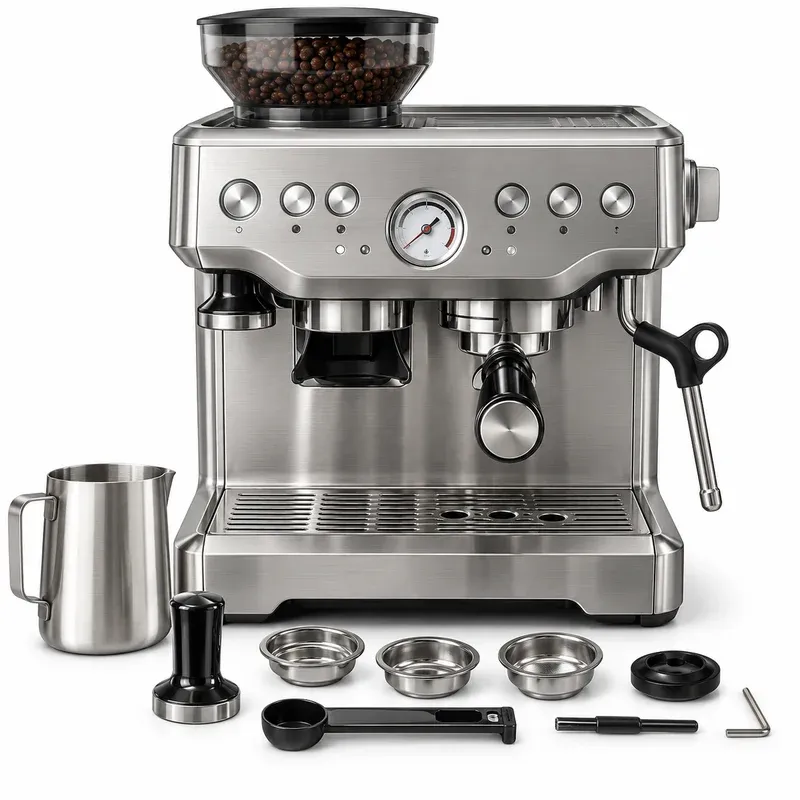
The Barista Express (BES870XL) has a built-in conical burr grinder with 16 settings, a 54 mm portafilter, a pressure gauge and a manual steam wand. It holds 67 oz (2 L) of water and measures 12.5 × 13.8 × 15.9 inches with the bean hopper. Its Thermocoil heater is slower between shot and steam than the Pro’s.
Best overall
Breville Barista Express Espresso Machine (BES870XL)
- Best for
- One-box espresso with a grinder built in
- Why it's here
- Breville's best-known all-in-one: a conical burr grinder, a 54 mm portafilter, a Thermocoil heater, a pressure gauge and a manual steam wand.
- Watch out
- 15.9 in tall with the bean hopper, so check the gap under upper cabinets.
- Price
- $$$ · Splurge
What we like
- Pro: Grinder included
- Pro: Pressure gauge
- Pro: Big 67 oz tank
Keep in mind
- Con: Tall hopper needs clearance
- Con: Built-in grinder has less range than a separate one
Check Price on Amazon for Breville Barista Express Espresso Machine (BES870XL) (opens in a new tab)
Affiliate link · Price may change
Barista Pro: best for daily lattes
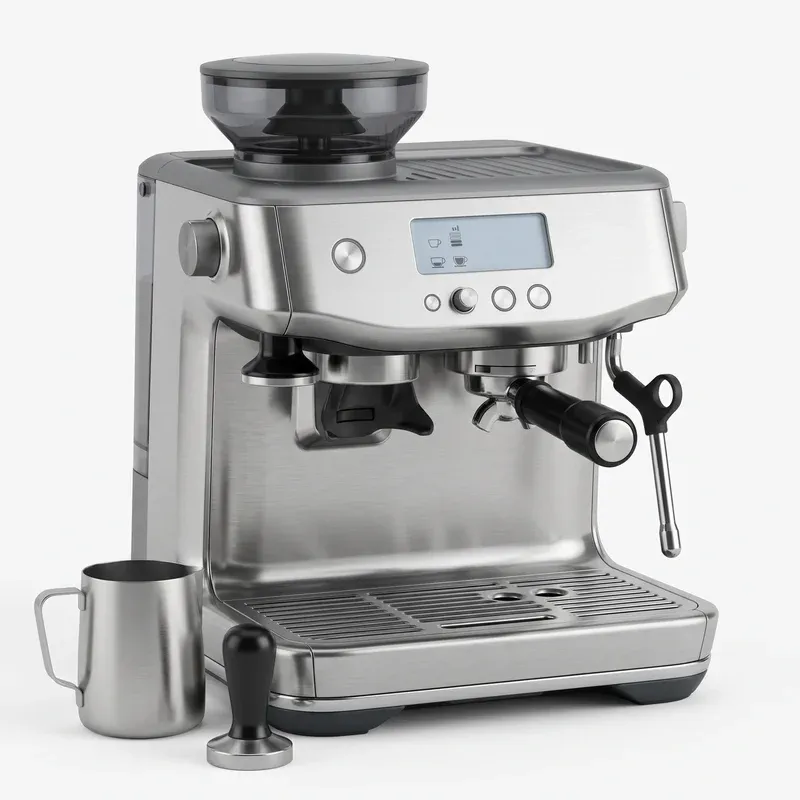
The Barista Pro (BES878) uses ThermoJet heating, rated at 3 seconds to extraction temperature, and PID control within ±2 °C (±3.6 °F). Its grinder has 30 settings, the hopper holds 1/2 lb of beans, and an LCD shows a shot timer. It is 14 × 13 × 16 inches and carries a 2-year warranty.
Best for milk drinks
Breville Barista Pro Espresso Machine (BES878BSS)
- Best for
- Built-in grinder with faster heat-up and a screen
- Why it's here
- A Barista Express with an LCD and ThermoJet heating: 3-second heat-up, built-in conical burr grinder, 67 oz tank and a 1/2 lb hopper.
- Watch out
- 16 in tall with the hopper by Amazon's listing; tight under 18 in uppers.
- Price
- $$$ · Splurge
What we like
- Pro: 3-second heat-up and fast steam switch
- Pro: PID temperature control
- Pro: LCD shot timer
Keep in mind
- Con: Grinder is a learning curve
- Con: Wide at 14 in
Check Price on Amazon for Breville Barista Pro Espresso Machine (BES878BSS) (opens in a new tab)
Affiliate link · Price may change
Infuser: best if you already own a grinder
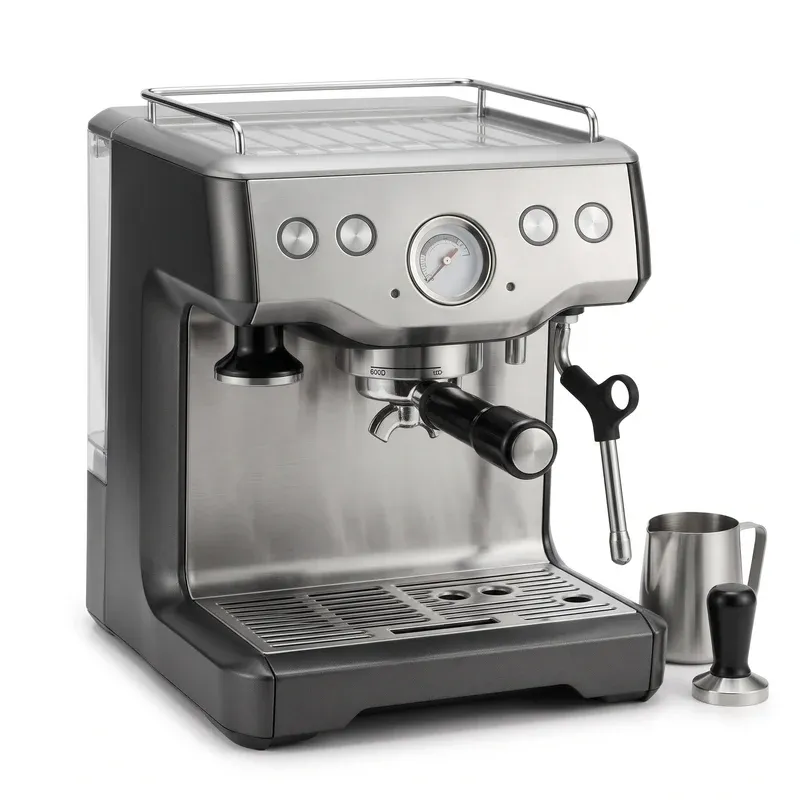
The Infuser (BES840) has no grinder, but it has a pressure gauge, low-pressure pre-infusion and PID temperature control adjustable in 2 °F steps. It holds 61 oz of water and stands 13.25 inches tall, the shortest pick here. Pair it with a good burr grinder.
No grinder
Breville Infuser Espresso Machine, Black Sesame (BES840BSXL)
- Best for
- Pairing with a grinder you already own
- Why it's here
- A no-grinder Breville with a pressure gauge, PID temperature control, low-pressure pre-infusion, a 61 oz tank and a 1650 W steam wand.
- Watch out
- No grinder built in; budget for one, or use pre-ground with the dual-wall basket.
- Price
- $$ · Mid
What we like
- Pro: Pressure gauge helps you learn
- Pro: Shorter than grinder models at 13.25 in
- Pro: Volumetric 1- and 2-shot buttons
Keep in mind
- Con: Older Thermocoil design, slower than ThermoJet
- Con: Grinder extra
Affiliate link · Price may change
What is the difference between the Barista Express and Barista Pro?
The Barista Pro heats in 3 seconds with ThermoJet, has 30 grind settings and a 2-year warranty; the Barista Express uses a Thermocoil heater, has 16 grind settings and a 1-year warranty. Both use the same 54 mm portafilter and a 67 oz tank.
The table below lines up the specs from the Amazon listings and a spec comparison by The Espresso Report.
| Spec | Barista Express (BES870XL) | Barista Pro (BES878) |
|---|---|---|
| Heating | Thermocoil, no published heat-up | ThermoJet, 3 s |
| Grind settings | 16 | 30 |
| Display | Pressure gauge | LCD with shot timer |
| Water tank | 67 oz (2 L) | 67 oz (2 L) |
| Size (W × D × H) | 12.5 × 13.8 × 15.9 in | 14 × 13 × 16 in |
| Warranty | 1 year | 2 years |
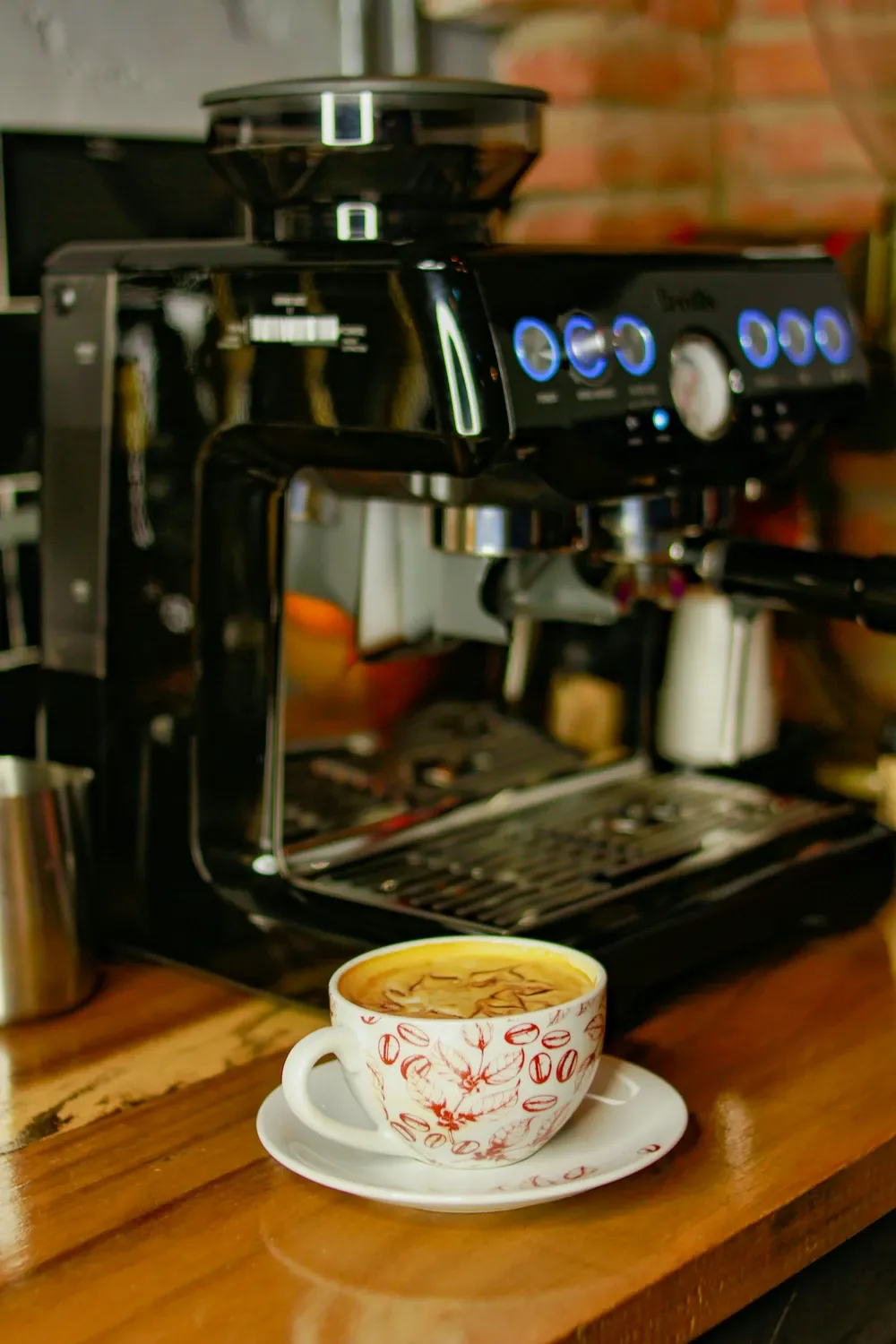
The heat-up gap matters most for milk drinks. With the Express you pull the shot, then wait for the steam to build; with the Pro you switch straight to steam. If you drink one straight espresso a day, that gap barely matters.
Do you need a Breville with a built-in grinder?
You need a built-in grinder only if you don’t already own an espresso-capable burr grinder; a Barista machine saves about 5 inches of counter compared with a separate grinder. If you own one, the Infuser or a Bambino gives you more machine for the money.
Fresh, fine, even grinding is one of the biggest factors in espresso, so the grinder is never optional. You just choose where it lives:
- Built in (Barista line): one plug, one footprint, and the grinder doses straight into the portafilter.
- Separate (Bambino, Infuser): you can upgrade the grinder later without replacing the machine.
- Automatic (Oracle line): the machine grinds and tamps for you, at the top of Breville’s price range.
The Bambino family is the no-grinder route most people consider. Breville rates the Bambino’s ThermoJet heater at 3 seconds, its tank holds 47 oz (1.4 L), and it is 6.3 inches wide. The Bambino Plus adds an automatic steam wand that textures milk hands-free and a 64 oz (1.9 L) tank. Both use the same 54 mm portafilter as the Barista machines, so tampers and baskets carry over if you upgrade.
How do you use a Breville Barista Express?
To pull a shot on a Barista Express, grind about 18 g of beans into the double basket, tamp level, lock in the portafilter and press the 2-cup button while you watch the pressure gauge. Breville’s own product page names 18 g as the ideal dose for the 54 mm basket.
These 6 steps get you from beans to a first shot:
- Fill the tank and the hopper. Use fresh beans; the 1/2 lb hopper on the Pro holds about a week for one person.
- Set the grind size in the middle of the range for your first try.
- Grind into the single-wall double basket. The dual-wall baskets are for pre-ground coffee.
- Tamp level with the tamper, then wipe loose grounds off the rim.
- Brew a double shot and watch the gauge needle. On the Express, it should sit in the marked espresso range.
- Adjust one step at a time. If the shot runs fast and the needle stays low, grind finer; if it barely drips, grind coarser.
Steam milk right after the shot. On the Express, give the steam wand a few seconds to build pressure first; the Pro is ready almost at once.
Which Breville accessories do you actually need?
You need 3 accessories that Breville doesn’t put in the box: a knock box, a small scale and a tamping mat. The Barista Pro already includes a 480 ml (16 oz) stainless milk jug, the Razor dose-trimming tool, a cleaning kit and a water filter, per its Amazon listing.
- Knock box: tap pucks into it instead of carrying them to the trash after every shot.
- Scale with a timer: weigh the 18 g dose and the shot, so you change one thing at a time.
- Tamping mat: protects the counter edge and the portafilter spout while you tamp.
Everything else, from a bigger milk pitcher to a distribution tool, is optional. Start with the 3 above and add tools once you know which step frustrates you.
Will a Breville fit under your cabinets?
The Barista Express and Barista Pro stand 15.9 to 16 inches tall with the hopper, which leaves only about 2 inches under a standard 18-inch upper cabinet. The Infuser leaves about 4.75 inches, and a Bambino about 6. Width and the outlet matter just as much, so check all 3 before you buy.
Pour-in hoppers need room above them, so plan to slide an all-in-one forward to add beans. For depth, a Barista Express needs a counter or cabinet top of about 16 inches once you add 2 inches behind it for the cord and tank. My coffee bar cabinet guide lists cabinets by top depth, and the countertop coffee station guide shows full layouts.
Width adds up faster than people expect. A Barista Pro is 14 inches wide, and the Breville Knock Box 10 beside it is 7 inches, so plan about 21 inches before you add a spot for mugs. A Barista Express with the same knock box needs about 19.5 inches. An Infuser plus a separate grinder lands in the same range.
Check the outlet too. The Barista Pro draws 1680 W and the Infuser 1650 W, so give the machine its own wall outlet rather than a strip shared with a kettle.
How do you clean a Breville espresso machine?
Clean a Breville in 3 layers: purge and wipe after every shot, backflush with a cleaning tablet when the Clean/Descale light flashes, and descale when it glows solid. The manuals for the Barista machines describe the tablet cleaning cycle step by step.
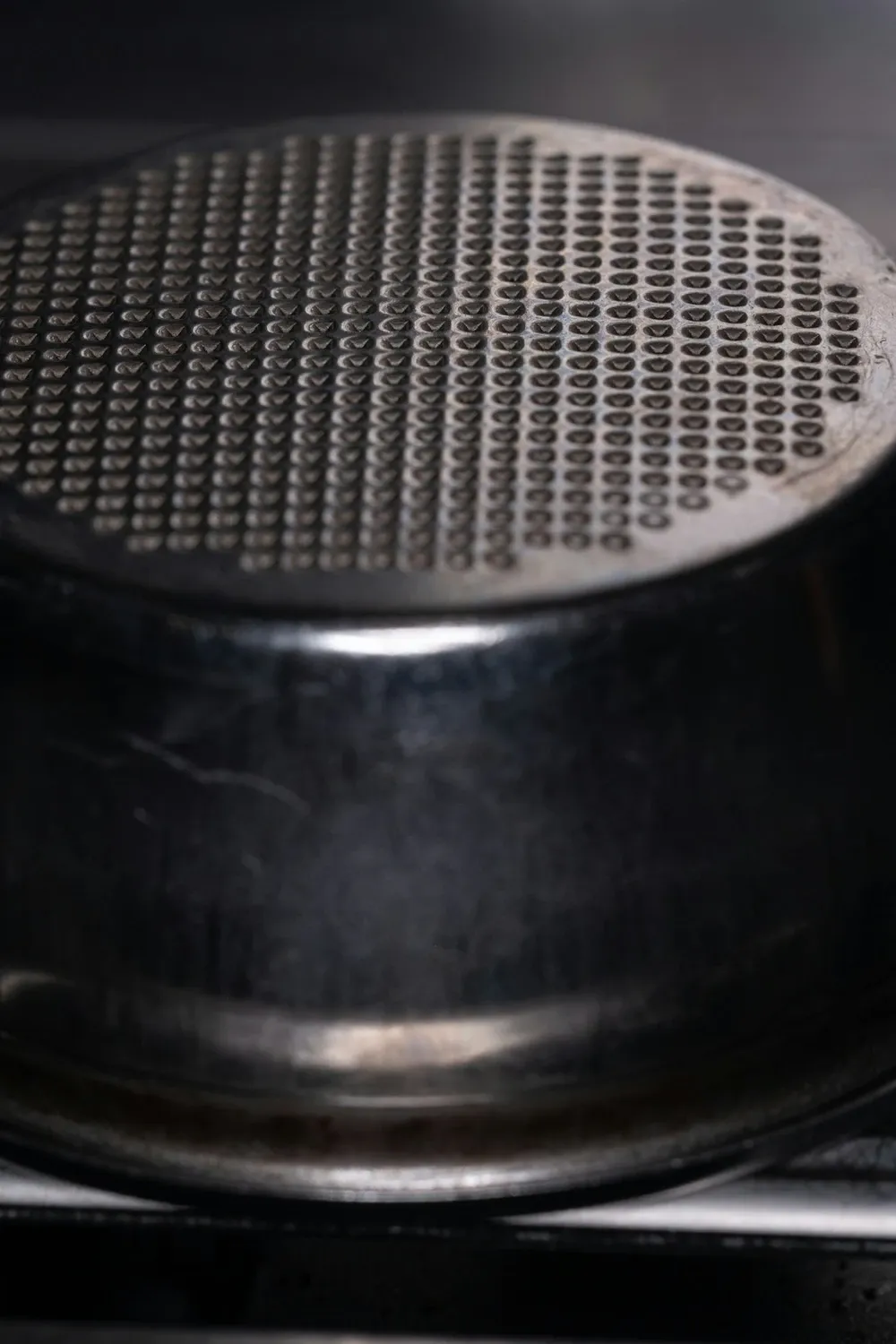
This schedule covers every Breville in this guide:
| When | Task |
|---|---|
| After every shot | Knock out the puck, rinse the basket, flush the group for 2 seconds |
| After every milk drink | Wipe and purge the steam wand right away |
| When the light flashes | Cleaning cycle: tablet in the single-wall basket with the cleaning disc |
| When the light is solid | Descale with a descaler made for espresso machines |
| About every 3 months | Replace the water filter in the tank, if your model has one (check your manual) |
| Monthly (grinder models) | Empty the hopper and brush out the burrs |
A knock box makes the daily step easy, because you can tap out about 10 pucks before emptying it. Breville sells branded cleaning tablets and descaler, but the Amazon listings I checked were sold by resellers or out of stock, so I’m not linking them. Any espresso-machine cleaning tablet in the size your manual calls for will do.
Daily cleanup
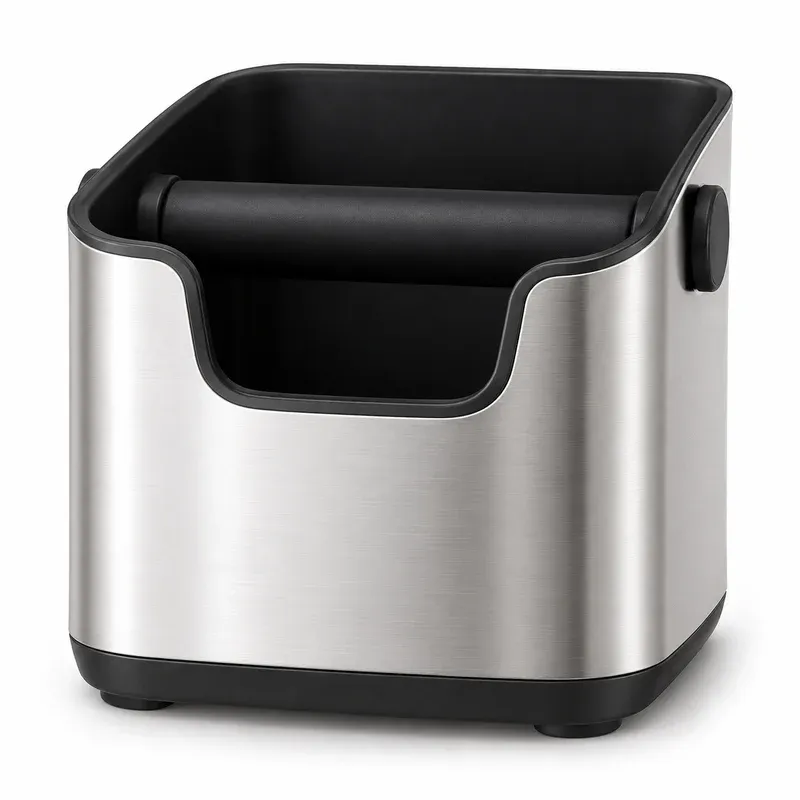
Breville Knock Box 10 (BEA501BSS)
- Best for
- Anyone with a semi-automatic espresso machine
- Why it's here
- Stainless knock box with a removable knock bar. Holds about 10 used espresso pucks, so you are not walking to the trash after every shot.
- Watch out
- 7 in square. On a tight counter, empty it daily; wet pucks smell by day two.
- Price
- $$ · Mid
What we like
- Pro: Removable bar for cleaning
- Pro: Matches Breville machines
- Pro: Small enough to store on the drip tray (maker)
Keep in mind
- Con: Pricier than generic knock boxes
- Con: Plastic inner tub
Check Price on Amazon for Breville Knock Box 10 (BEA501BSS) (opens in a new tab)
Affiliate link · Price may change
For the rest of the tools around the machine, see my coffee bar essentials list.
Who should skip a Breville espresso machine?
Skip a Breville espresso machine if you want coffee with zero learning curve, drink mostly big mugs of drip coffee, or have less than 13 inches of free counter width. A Breville rewards practice; a capsule machine doesn’t need any.
- No learning curve: a Nespresso machine brews espresso and lungo at the press of a button. Compare models in my Nespresso machine guide.
- Big mugs, many flavors: a pod brewer from my Keurig coffee maker guide.
- Tiny counter: an Essenza Mini is 3.3 inches wide; even the Bambino needs about 6.3 inches plus a grinder.
If you want to learn espresso at home and have the counter for it, a Barista Express or Pro is the shortest path from beans to a latte. See every machine type on the coffee machines hub.
Frequently asked questions
What is the best Breville espresso machine for beginners?
The Barista Express is the classic beginner pick: grinder, pressure gauge and steam wand in one box, with dual-wall baskets that forgive an uneven grind. Serious Eats prefers the Bambino Plus for its automatic milk wand, but you'd need a separate grinder for it.
Is the Breville Barista Pro worth it over the Barista Express?
Yes, if you make milk drinks most days. The Barista Pro's ThermoJet heats in 3 seconds and switches to steam with no wait, it has 30 grind settings against 16, and it carries a 2-year warranty instead of 1. For one straight shot a day, the Express is enough.
What does the flashing light on a Breville mean?
On Barista machines, a flashing Clean/Descale light asks for a cleaning cycle: a cleaning tablet in the single-wall basket and the cleaning disc, run as the manual describes. A solid light asks for descaling. Check your model's manual for the exact steps.
How long do Breville espresso machines last?
Breville doesn't publish a lifespan. The warranty is the clearest signal: 1 year on the Barista Express and Infuser listings, 2 years on the Barista Pro. Regular backflushing, descaling and replacing the water filter are the habits that keep any of them running.
Free coffee bar size worksheet
Six numbers to measure before you buy a cabinet, cart or machine, plus a page of typical machine sizes and cabinet clearances.